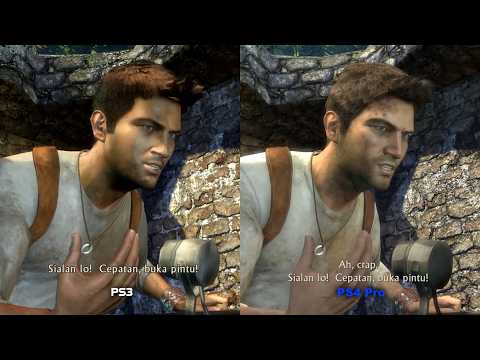
A comparison between the original Uncharted: Drake's Fortune on the PS3 and the version of the game on the Nathan Drake Collection on the PS4. I am using a PS4 Pro, and I have Super Sampling on with my Elgato HD60s which is only a 1080p capture card. I probably should have used my EVGA XR1 Lite or my Monster HDMI Capture card which have 4K passthrough, but they also just record at 1080p 60. The PS3 version is 720p scaled to 1080p in OBS and the PS4 Pro version is 1080p. Both have been upscaled to 4K in my editing software.
I know that Digital Foundry did a much more in-depth comparison between these versions some years ago, but I still thought it would be interesting to do a side-by-side comparison of my own.
Gameplay-wise, the PS3 version feels harder on Normal difficulty which I am playing on. I'm not sure if that's just the difference between the framerate between the versions. The PS4 version runs at twice the framerate of the PS3 version, so maybe the aiming and movement are just easier. Or maybe Bluepoint did make it slightly easier for modern gamers. Not sure really.
Uncharted Drakes Fortune,Uncharted PS3 vs PS4 Pro,Uncharted comparison,Drake's Fortune remastered,Uncharted graphics comparison,PS3 vs PS4 Pro graphics,Uncharted 1 comparison,Naughty Dog Uncharted,Uncharted remaster vs original,PS3 gameplay vs PS4 Pro,Uncharted no commentary,Uncharted visual upgrade,Uncharted frame rate comparison,Uncharted resolution test,classic vs remastered gaming,PS4 vs PS3,PS4,Playstation
These aren't serious benchmarks, I'm just eyeballing the averages here.
In my previous video I said I was done upgrading my HP slimline 270
desktop, and I thought I was, but I couldn't help the urge to tinker
around with it more, so I picked up the Dell OEM RX 550 4GB GPU to see
how much of an uplift it gave my little HP Slimline which is now, maybe
around or just below the specs of an original Xbox One. It was hanging
around an Xbox 360 level, so it's almost a console generation leap in
performance.
For the videos from BasicDadTech (for some reason I've always read his
channel as BasicTechDad so apologies for mispronouncing the channel) go
here:
Knack
is a game for which I can't figure out the demographic. The cutscenes
make it look like a kids' movie, but the gameplay is incredibly basic
and brutally hard for no good reason. I recently picked this up at my
local GameXchange for $7, having heard about it previously. This is a
game I really wanted to like, but frustrating design ideas and a lack
of gameplay depth make this game a chore to play.
First and foremost, the enemies in
this game deal a ton of damage. I played through this game on normal,
but no matter how big Knack grows in size, he dies in two or three
hits, tops. Normally, this wouldn't be a big deal, but the game is
filled with cheap-hitting enemies, some of which shoot Knack from
afar or have attacks that allow them to dash across the playfield for
a cheap shot while he's busy fighting other foes.
The core gameplay comes down to
replaying each section of the game over and over again until you get
a perfect run or collect enough yellow energy to hit enemies with a
super attack. The unbalanced damage dealt by enemies makes for a game
that is challenging for all the wrong reasons. It's demotivating to
have to replay a large section of the level repeatedly because you
misjudged one dodge and were one-shotted by an overpowered enemy. I
don't mind difficulty; some games can be difficult but satisfying
when you beat a tough level. However, the repetitive and unfair
feeling of Knack makes for a game that is frustrating—difficult but
with no rewarding payoff for completing a level.
What doesn't help the situation is
Knack's extremely limited attack abilities. When you start the game,
Knack has a basic three-hit combo with which to attack his foes. When
you end the game, Knack has the same three-hit combo with which to
attack his foes. That's right; Knack has one combo to use throughout
the entire game. On top of his limited combo, he also has a mostly
useless air attack that has the smallest range I've ever seen. If
you're not almost directly above the enemy you are air attacking,
Knack will miss his target.
He is also equipped with a mostly
useless dodge mechanic. Like God of War (the original God of War, not
the new ones), hitting the right analog stick will see Knack dodging
out of the way of attacks. However, unlike Kratos, Knack's dodge is
just a little too short to be effective, and Knack pauses for a split
second after each dodge, leaving him open for attack. It lacks
effective range and leaves you open for attack, meaning that it
doesn't work as a dodge but can be useful to close the distance and
attack enemies after staying out of their attack-combo range. It's
better used as an offensive attack than as an actual dodge.
Throughout the game, Knack can
break yellow crystals to fill a meter at the top of the screen. When
the meter is filled, he can then perform super moves. The game is
self-aware of its own difficulty in that, when you die, the meter
doesn't drain. In fact, in tough areas, it is sometimes better to
expend a number of lives to repeatedly break the yellow crystals to
fill the meter so you can unleash a super attack on your foes to
clear them out in order to progress.
When the game's difficulty curve
kicks in, every new area of this game feels like a challenge mode
because of the absurd amount of damage enemies dish out and the
sometimes unfair-feeling checkpoints. The frustration could be
mitigated if the enemies dropped life pickups or even yellow crystal
pickups, but they don't drop anything (at least until you complete an
in-game gadget that makes them drop yellow crystals), making the
combat feel all the less rewarding. Any and all life pickups are in
predetermined parts of the level, and they rarely give you enough
life to actually make a difference.
There are some hidden areas in the
game, but overall, there's almost no extra exploration to be had.
There are hidden chests that contain gadget parts, which, once
formed, can enhance Knack's abilities, but I have yet to complete one
to see if that improves the game in any way. The game is pretty
linear, without much extra to see or find outside of the gadgets.
By the time I completed the first
gadget, the tedium of the gameplay had already set in, and it was too
little, too late. The gadgets unlock things that should have just
been basic gameplay balancing, like giving more yellow energy from
the crystals, even if it still doesn't give you that much extra. The
gadget and crystal hunt do add more to find if you're a completionist
kind of gamer, but if I hadn't decided to do this review last minute,
I would probably only play this game for a couple of levels before
the repetitive gameplay made me lose interest. It would be a game I
would pop in, play a level or two, get bored of quickly, and move on.
I really wanted to like this game.
It has a great art direction and beautiful visuals (despite some
massive framerate problems in some areas) that can deceive you into
believing there's a higher quality product than your first impression
would have you believe, but there really isn't much more to it, which
is a shame because it feels like this game should have had more to
it.
There are some good ideas at play
in the game, like Knack growing into a larger form of himself to
where he can deal more damage to enemies; however, it's still
hampered by the fact that some enemies will still kill him in three
hits or less. The whole game just feels unbalanced due to the
exorbitant amount of damage dealt by enemies versus the lack of
health pickups available and the repetitive lack of any variety in
the combat.
I will admit that now that I have
beaten the game, which opens up new modes like time attack, the
coliseum mode, and the ability to go back and play any section of the
game, the game has grown on me more. However, that first playthrough
felt like a slog. I have gotten better at facing the opponents and
death traps in each level, thanks to the many deaths it took per
section, so I have improved at the game. It's growing on me more now
that I can casually jump back into a section of a level and play.
However, during my playthrough, I lost complete patience with the
game for the second half, instantly skipping any and all
cutscenes—not just the story ones, but also the mid-level ones that
show Knack doing things like jumping off a ledge to get to the next
part of the level. The more I play it, the more it grows on me, so I
am a bit mixed on the game overall. It's not a great game; sometimes
I was convinced it wasn't even a good game, but it's growing on me.
Visually, even with Boost mode on
with the PS4 Pro I am using for this footage, the game suffers from a
poor framerate in some areas, especially in the giant Knack scenes.
The visuals still look really good considering this was a launch game
for the PS4. I almost jokingly want to say that Knack is a game that
looks like a million bucks but plays like a Dollar Tree special.
From the art direction to the
quality graphics to the animation-quality cutscenes and the excellent
symphonic music score, you can tell that Japan Studio put a lot of
effort into everything but the gameplay, which is a shame. That being
said, I don't own Knack 2 as of yet, but in watching some gameplay
samples of the game on YouTube, I can tell they made quite a bit of
improvements to the game in the sequel. One of these days, I will
probably pick up the sequel, which looks to be anywhere from $10 used
to $25 for a brand new copy on eBay as of making this video.
The Bottom Line: I really
wanted to like Knack a whole lot more than I did. The game is growing
on me the more I play it, which could just be Stockholm syndrome. I
have gotten my $7 worth of entertainment out of it, but it's
definitely a game that is hard to recommend to most gamers out there.
This is a game that feels three generations too late and would have
made a perfectly bland but forgettable PS1 game. It's not the worst
game ever, and I'd say it's a bit better than some of the mainstream
reviews made it out to be, but its inflated difficulty, thanks to the
unbalanced damage dealt by enemies mixed with its repetitive and
tedious-feeling gameplay, really bogs this game down into a slog.
That first playthrough is rough, and the game drags on longer than it
should. This is a game that overstays its welcome, and I can only
recommend it to the most forgiving and patient gamers out there. If
you're an incredibly forgiving gamer who can find enjoyment in even
the most flawed games, find this game for cheap and give it a shot.
It does grow on you over time.
Knack PS4 review,Knack PS4 Pro gameplay,Knack game review,PS4 Pro game reviews,Knack gameplay,Knack PS4 Pro graphics,Knack review 2025,PlayStation 4 game reviews,Knack review from a nobody,Knack PS4 tips,Knack PS4 Pro performance,Knack walkthrough,Knack PS4 features,Knack game mechanics,PS4 Pro exclusive games,Knack review video,Knack PS4 impressions,Knack game analysis,
I
was at my local Walmart the other day, and I always find myself drawn
to that little section on the back wall of the electronics section
that has composite cables, universal TV remotes, signal splitters,
and sometimes even upscalers. I was browsing that section when I
noticed a $21 Monster video capture card on the shelf, so I decided
to buy it. I'm a big fan of showcasing budget options for anyone
looking to get into making videos for YouTube. A lot of tech
channels, in particular, are way out of touch when it comes to the
budget market. This is especially true of most of the big PC gaming
tech channels, but that's a different subject for another time.
Now,
the official name for this capture card is the Monster 4K Black Audio
Video USB 3.0 HDMI Capture Card, which is deceptive. It has 4K
pass-through but only records at 1080p 60fps. So, you can pass a 4K
signal through the capture card to your TV, but it only records at
1080p. I read the packaging and understood what it was saying, but it
might mislead some people into thinking they are getting a 4K capture
card for $21 instead of a 1080p capture card. So, that's kind of
scammy, even if $21 is still dirt cheap for a 1080p60 capture card.
Another
sort of deceptive part about this product is that it is a blatant
reskin of a generic capture card that is already available on Amazon.
However, the Amazon version and the Monster version are around the
same price, so there's not a big markup difference. The Monster
capture card also comes with some nice packaging and a thick but
short USB 3.0 to USB 3.0 cable. The USB cable is only around 2 feet
long, which might not work well depending on your setup.
This
capture card is plug-and-play with OBS. You plug it into a USB 3.0
slot, and OBS should recognize it and let you set it up to capture
video and sound from it. It's pretty simple to set up. I set my OBS
settings to record at 1080p 60fps, and it works great. The 4K
passthrough, which I've been using with my PS4 Pro and on my current
PC, works great.
I
made a community post about this card when I bought it, and since
then, I have put it through various testing. At first, I was curious
as to whether or not the card would recognize and record 480p or 720p
signals. It does. I pulled out my Retrotink 2X Pro, which can have
issues with some capture cards, and it worked great. The only bad
part for aspect ratio purists is that it seems to stretch the
Retrotink's image into widescreen, but the aspect ratio can be fixed
in your editing software.
For
720p, I pulled out my Hyperkin Retron 5 and my Hyperkin cable for the
N64, and it captured both the Retron 5 and Hyperkin 3-in-one cable
without any issues. Then, I was curious to see what would happen if I
hooked up my gaming laptop to it to capture footage from a game that
was running at 120 frames per second. I did notice some screen
tearing, but the footage still looks pretty good. If you're looking
to capture PC benchmarks, this can work, but there will be some
tearing in the footage at times. If you're looking to review or do a
let's play, you can always limit the framerate down to 60 frames per
second if you're capturing footage for non-benchmark videos. I'm sure
there are some OBS settings that can help with the tearing issue as
well.
For
the final end-boss of video capturing, there is the PS3's HDCP lock,
which stops all other capture cards in their tracks. I normally use a
signal splitter with my HD60s, which allows me to capture PS3 footage
through the HDMI cable. However, for the Monster capture card, you
can pass the PS3 through the card, and it doesn't care about HDCP.
This is the title screen for the special features disc of Revenge
of the Sith,
which, by the way, did you know you can put the special features disc
into an original Xbox and play a demo of Battlefront
2?
I forgot about that. The rest of the PS3 capture came out fine as
well.
So
far, the only downside I have found with this capture card is that,
in using the slightly slower USB 3.0 to USB 3.0 cable—unlike the
HD60S and XR1 Lite, which use a Type C to USB 3.0 cable—you can't
play the game through your OBS screen. Sometimes, people don't have a
TV to hook it up to or an extra monitor, and with the speed of the
more expensive options like the Elgato, you can pretty much play the
games right off your OBS screen if you have no other options. Another
downside for some is that it also doesn't capture HDR, but neither do
my other 1080p capture cards.
I
can't comment on long-term reliability as of yet; if any issues come
up, I will let you know. However, small issues aside, this Monster
USB 3.0 capture card might just be the Budget King of 1080p capture
cards. I will show some gameplay samples after I am done talking to
demonstrate the quality so you can judge for yourself. If you're on a
budget and are looking to start a YouTube channel where you need to
capture console footage in particular, don't overlook this $21
capture card. Larger channels will always tell you Elgato, Avermedia,
or EVGA, but don't overlook this budget card. So far, I'm very
impressed with it. I'm going to use it as my daily driver for the
next while just to see if any long-term reliability issues arise. For
1080p quality, it's really impressive. Starting a channel doesn't
always have to be expensive.
Given the nickname "Goddess of War" at the time, Heavenly Sword was, unquestionably, inspired by the exploits of everyone's favorite Spartan. Its story-focused design, use of quick time events, some of its combat elements, and general design are definitely an homage to God of War; however, Heavenly Sword still puts its own unique spin on the formula. Coming out just six months after God of War II meant that reviews of the day compared it directly to God of War, and most of them concluded that the game was God of War but with a female protagonist, which isn't an entirely fair assessment. In its own right, Heavenly Sword is still an excellent hack-and-slash romp that is far from a one-to-one copy of God of War.
The PS3 had a rough start after it launched. I've talked about it in a couple of my past videos, but that first year the system was on the market saw very slim pickings when it came to console-exclusive games. There were a number of multiplatform games released as well, but there weren't a lot of reasons to buy a PS3 if you already owned an Xbox 360. In my Resistance: Fall of Man review, I said that it isn't an exaggeration to say that Resistance almost single-handedly kept the PS3 afloat in the West for its first year on the market. Resistance was THE premier exclusive title for the system until Uncharted hit almost one year later to the day of the PS3's release. Resistance, its Blu-ray player capabilities, and the promise of Metal Gear Solid 4, on top of the PlayStation brand recognition, were really the best reasons to pay the extra $100–$200 for a PS3 over an Xbox 360. Because when it came to the library of exclusive games, there was no competition; the 360 had a much larger library and a more (and I would argue a better library of) console exclusives at that time. In the first year of the PS3's life, it was hard to justify buying one over an Xbox 360.
In saying that Resistance was the premier PS3 exclusive, that's not to say there weren't other noteworthy exclusives for the system in its first year on the market. MotorStorm was another popular release, and games like Warhawk, Lair (which was a high-profile flop), Ninja Gaiden Sigma, and finally, Heavenly Sword were also high-profile exclusives for the system as well.
2007 was an exceptionally good year for action gamers who owned a PS3. On March 13th, Sony Santa Monica Studios released the venerable God of War II on the PS2, which was playable on the PS3 thanks to backwards compatibility. God of War II was a huge release for the PS2 and is still one of the best games on the system, taking everything that was great about the original and expanding upon it while cutting out some of the parts gamers hated, like that stupid Hades level in the original.
Later that year, on July 3rd, 2007, Team Ninja released Ninja Gaiden Sigma on the PS3. This was a great port of a great game, but also not a system seller, as while it was certainly a good exclusive for the PS3, it was also just an enhanced edition of a game that had already been released twice over on the original Xbox. It was great to see Ninja Gaiden on a PlayStation console for the first time, but I don't imagine a lot of people bought a PS3 exclusively for Sigma either.
Finally, on September 12th, Heavenly Sword was released, and considering God of War III was still two and a half years away, Heavenly Sword was the closest thing to a next-generation God of War game PS3 owners would see for a long time. Heavenly Sword was developed by Ninja Theory, who would later release Enslaved: Odyssey to the West and Hellblade, and tells the story of Nariko, whose birth was in defiance of a prophecy in her clan that one day a son would be born who would wield the Heavenly Sword against a powerful enemy. The Heavenly Sword is a sword protected for generations by her clan and is said to have been forged by a bloodthirsty god. Her being born a woman instead of a man is seen as a curse upon the clan, which is now being hunted down by a bloodthirsty king intent on recovering the Heavenly Sword; the clan's true feelings about Nariko come back to the forefront throughout the game.
The combat system in Heavenly Sword is more focused on countering attacks than the visceral combat feel of God of War. Nariko's offense is divided between three stances: speed, power, and range. The range attack, which is performed by attacking while holding L1, can deflect incoming arrows, crows, and other projectiles, but it is unable to counter any enemy attacks. The speed attack is the default attack, represented by a blue aura; it can be used to counter regular enemy attacks—those attacks where the enemies have a blue aura around them while attacking. The heavy attack, which is performed by attacking while holding R1, is represented by an orange aura and is useful against more heavily armored opponents and for countering heavy orange attacks from enemies.
On top of the three attack stances and counter-focused combat, Nariko can also pick up various items like swords and shields to throw at enemies, including the bodies of vanquished enemies, which can lead to some pretty humorous outcomes. Holding down the throw button after you throw an object slows down time as the camera zooms in on the object, allowing it to be controlled by the player during flight. This Aftertouch, as it's dubbed in the manual, can also be used for Kai's Crossbow or in those scenes where Nariko is defending a fortress against encroaching catapults and an invading army.
Seeing as this was an early PS3 game, the Aftertouch effect has forced Sixaxis controls to guide the projectile through the air. I got about halfway through the game before I realized that all the Sixaxis controls (no doubt imposed upon this game by Sony) could be turned off in the options menu, which I promptly did. If you've ever played this game and hated the parts that use motion controls, you can simply shut them off.
Heavenly Sword is too old to have trophy support, meaning there's nothing here for those trophy hunters out there. If you remember, Sony didn't roll out trophies as their response to Xbox's Gamer Score until the latter half of 2008 and didn't make them mandatory until 2009. Even Uncharted would have to be patched almost a year after release with trophy support. That being said, Nariko is graded on her performance in each section, and there are a number of making-of featurettes and new combos that can be unlocked.
The new combos come in handy because there are quite a few of them that are block-breaking combos, which I started using in the game long after I faced the most annoying block-everything opponents in the game. In fact, there is an entire list of combos for each stance that's available in the pause menu. I suggest you study and familiarize yourself with the block-breaking combos in particular.
On top of multiple unlockable combos, three different sword stances, and a big emphasis on countering opponents' attacks, Nariko can also pull off Superstyle Attacks, where, upon earning enough style points, up to three globes in the Superstyle disk within Nariko's health meter light up, allowing Nariko to unload a superstyle attack on an enemy, which will kill that enemy and sometimes damage the surrounding foes as well. The Superstyle attacks were another feature I forgot to use until near the end of the game on my first run. They're very effective; I just forgot they were a thing for a while.
Overall, the combat feel of the game is excellent. Yes, for the time of its release, being released in the same year as God of War II and having a lot fewer similar games on the market to compare it to than we do today, mainstream reviews would inevitably compare Heavenly Sword directly to God of War without much nuance. However, years removed from unfair comparison reviews, Heavenly Sword still stands on its own as an excellent action game whose combat system is incredibly fluid and unique. While yes, the combat feels a little more reactive in nature due to the emphasis on countering attacks, it does give the combat a more balanced feel of when to attack versus when to dodge and when to counter.
In fact, the counters are fun and become quite addictive to try and pull off in time to watch as an enemy attacks you, only to see Nariko stylishly launch them across the screen or put them on the ground and snap their neck. It adds a lot of depth and fluidity to the combat, whereas in most games, you'd just block enemy attacks until the window to attack again is open, but players who master this combat system will basically be able to attack without interruption if you time the counters right.
The fact that the counter button is also an attack button helps the player counter various attacks without disrupting their own attacks. Having an attack button as the counter button does, however, mean that I often felt like I countered more attacks by accident as opposed to using precise timing and skill to counter. The combat is fluid and sleek, with a more graceful flow to it than many similar games.
Overall, the combat in Heavenly Sword is fun and distinct in feel: it's stylistic in nature, and the stance swapping and counter system bring a lot of extra depth and strategy to its battles. This isn't the visceral, rage-filled combat of God of War, but it was never trying to be God of War in the first place. Inspired by it in many ways? Yes. A replacement for it? No, outside of it being a stand-in game for not having a God of War game available on the PS3 early in its life cycle.
In fact, outside of some quick time events and some similar elements in the dodge roll mechanic and air combos, Heavenly Sword really isn't a God of War clone, especially in its set pieces. The game chooses set pieces like manning a cannon to defend a fortress or Kai's crossbow scenes over the exploration and puzzle elements of the God of War games. Every God of War game has some set pieces, but also scenes of intense action followed by exploration and puzzle elements. Heavenly Sword has very minimal exploration or puzzle elements. There are a couple of light puzzle scenes, but overall, Heavenly Sword, in many regards, is more of a straight-up action-focused game than even God of War.
Most of the set pieces do just come down to using the Aftertouch ability to hurl either crossbow bolts or cannonballs at moving targets. These scenes were, no doubt, added to promote the Sixaxis capabilities of the DualShock 3, but these scenes are well done and play a lot better if you shut off the motion controls in the options menu. To break up the action even more, there is even an entire level in the game where you play as Kai instead of Nariko. Kai's only means of attack is her trusty crossbow, making these scenes feel a lot more like a third-person shooter than a hack-and-slash style game. The scene is well done and plays well once you adjust to evading enemies to create distance so you can take them out with the crossbow.
When it comes to difficulty, on the default setting, I'd say the difficulty on normal is just right. Fans of these kinds of games will probably breeze through the game on their first run. I say this as someone who's more of a casual fan of this sub-genre because I don't go out of my way to play overly frustrating games. For example, I only recently bought Ninja Gaiden Sigma, and I casually pop it in to play here and there, but I've avoided the game for years because I know of its legendary difficulty. I have to get into a hardcore focus mood in order to tackle a game like Ninja Gaiden Sigma. In Heavenly Sword, while I did die a couple of times in the boss battles throughout the game, the only boss that gave me THAT kind of trouble (I'm sure you know what I mean by that kind of trouble) was the end boss. Granted, he's the end boss; he's supposed to be the one you die at a dozen or so times before you beat him. The boss battles themselves are well thought out and well designed, generally with each boss having three forms to fight. As I said, they aren't overly difficult once you learn their patterns, which might take a life or two to figure out. The only parts in the boss battles I found myself repeatedly failing at were the Quick-Time Event portions. I don't think I ever hit one on the first, and sometimes not even the second or third try. The good thing is the QTEs can be memorized because they're the same every time. If the normal difficulty is too easy, beating the game on the normal difficulty will unlock the “Hell” difficulty setting.
The overall controls in the game are responsive and tight during combat, with the biggest learning curve being switching stances to counter speed and heavy attacks. The crossbow aiming does feel a little imprecise, but you'll probably be using Aftertouch in most of your shots. Even with the Sixaxis controls, the Aftertouch controls okay. It's definitely a lot more precise shutting off all motion controls and using the analog stick, but if you're a fan of motion controls, they work decently enough.
Graphically, the art direction makes for a game that is still appealing to look at. The manual isn't clear if the game takes place in an entirely fantasy world or in our world, but the backgrounds and setting look like scenery from the Hallelujah Mountains in China, with parts of the castles and fortresses reminding me even of Ico, which I recently reviewed. The background settings of the game are gorgeous to look at and add to the atmosphere of the game.
While the game is still pretty to look at to this day thanks to its art direction, it also has that early PS3 look that I can't really describe. I'm not good at describing visual effects; I'm not Digital Foundry, but that lighting bloom gives everything a dreamy, glowy look, like a shiny halo around objects in the game, mixed with the fact that objects themselves look extra shiny at times for no reason. This definitely has early pre-Unreal 3 engine looks to it. Unreal 3 would become the go-to game engine on the PS360 and would make the vast majority of games on those systems look samey. You know how everyone is complaining about UE5 today and how it makes every game look the same nowadays? Same thing with Unreal 3 in the seventh generation.
It sounds crazy in a way, but because of the way early PS3 games looked, Heavenly Sword looks like it could take place in the same world as Lair. Its art direction and visuals are unique, but it's just the way early PS3 games looked. Even parts of Uncharted look like Heavenly Sword, and the big, open mountainous terrain looks similar to a lot of other PS3 games released around that time as well. My best way to describe it is that early PS3 look. If you know, you know.
The music in the game is excellent. Composed by Nitin Sawhney, and I'm not good at describing music, but some of it sounds like a mixture of Indian and Asian folk music, while other portions of the soundtrack feature big orchestral numbers thrown in for scenes like the last boss fight. It's all well composed, and its unique blending of styles gives the game a distinct feel, adding to the strange fantasy atmosphere of the game.
The voice-over work also adds to the strange fantasy atmosphere of the game. Featuring Andy Serkis of Gollum fame as King Bohan and a cast of other talented actors, the voice-over work in the game is, overall, well performed, with some of the characters, like Fox, being a bit too campy and over the top (isn't... that... right... Na-Ri-Ko?). Overall, the characters come off as a little weird, but that also kind of adds to the game. Some are over-the-top cartoon characters; others are incredibly serious, but somehow I actually found that it works for this game. The characters are definitely weird, but it almost feels like they are supposed to be a bit weird and over the top at times.
The Bottom Line: Heavenly Sword is beloved among early PS3 adopters for a reason. Its biggest flaw is its lack of trophy support and its short length. However, it does give players reasons to play through it a couple of times. This was a God of War stand-in game released in the first year of the PS3's life that was, I would say, unfairly compared directly to God of War when it hit. While the game draws inspiration from God of War, in the close to two decades after its release, far removed from those direct comparisons, it still stands as an exceptional action game whose fluid combat system, unique art direction, and storytelling focus help it stand the test of time. There's a good chance that most PS3 gamers missed this game thanks to its early release in the system's lifespan. It did sell over a million copies but was still considered a failure and was quickly forgotten due to the slow sales start of the system. If you're a fan of action games in the style of God of War, Devil May Cry, or even Ninja Gaiden, Heavenly Sword is worth picking up. Eighteen years after its release, it's still a fondly remembered cult classic for a reason.
And if you're a fan of Ninja Theory's art stylings and unique game
design concepts, you should also look into Enslaved: Odyssey to the
West, which plays like a mixture of God of War and Prince of Persia,
with even some Ico mixed with squad-based tactical strategy thrown in
for good measure. It's another unique game from Ninja Theory that I
think a lot of people are aware of nowadays. It was released on the Xbox
360, PS3, and is still available on Steam if you want to support the
developers that way. I don't know if the Steam version runs well on
modern hardware, but I've had good luck running UE3 games on my PC.
There's always the discussion tab on Steam if you have any issues.
=================================
=================================
Video Tags: Heavenly Sword,PS3,Heavenly Sword review,PS3 game review,action-adventure game,PlayStation 3,video game review,gaming,game review,Heavenly Sword gameplay,PS3 exclusive,cinematic gameplay,character design,game mechanics,story review,gaming nostalgia,PlayStation classics,action game,game graphics,gaming community,video game analysis,PS3 titles,game recommendations,Heavenly Sword characters,gaming history
My apologies that it looks so crummy, I had to run it through handbrake because Youtube's processing kept messing up the raw file. I had to upload this a couple of times because the processing on Youtube's end kept messing it up.
0:00 Introduction 2:38 Taito Legends 2 (PS2) 18:39 Armored Core 2 (PS2) 31:26 MDK (PS1) 47:22 Tomb Raider (PS1) 01:07:09 Grand Prix Challenge (PS2) 01:18:42 Skyblazer (Snes) 01:29:53 E.T. (Atari 2600) 01:41:08 All-Star Slammin' D-Ball (PS1) 01:47:24 Quake II 64 01:52:50 G.I Joe (NES) 02:04:15 Bloody Roar (PS1) 02:10:43 Tomb Raider 2 (PS1) 02:34:36 Ninja Warriors (Snes) 02:40:52 Castlevania Chronicles (PS1) 02:50:55 Robotron X (PS1) 03:00:46 Centipede: Infestation (Wii) 03:07:14 TMNT: Hyperstone Heist (Genesis) 03:19:24 Robotron 64 03:28:31 Food Fight (Atari 7800) 03:40:20 Blowout (PS2) 03:46:38 Mega Man (Nes) 03:59:19 Killzone (PS2,PS3) 04:21:23 Battletanx: Global Assault (N64) 04:34:02 Pinobee (PS1) 04:42:21 1942 (NES) 04:51:08 Super Dodge Ball (NES) 04:56:18 The Adventures of Cookie and Cream (PS2) 05:01:47 Gungrave (PS2) 05:09:27 MagMax (NES) 05:14:32 Syphon Filter 3 (PS1) 05:25:51 Donkey Kong Country (Snes) 05:33:14 Crazy Taxi (PS2,DC) 05:36:03 Motor Mayhem (PS2) 05:48:25 Disney's Treasure Planet (PS2) 05:52:11 ChuChu Rocket (DC) 05:56:19 Call of Duty: Finest Hour (PS2) 05:58:48 Magix Music Maker (PS2) 06:04:27 Katamari Damacy REROLL (PC) 06:13:25 Wanted: Weapons of Fate (PS3) 06:20:25 Dante's Inferno: Divine Edition (PS3) 06:34:21 Twisted Metal Black (PS2) 06:38:36 Einhander (PS1)
Just a compilation of 10 reviews I have previously uploaded on this channel. I wanted to use my Ryse: Son of Rome review in this one, but since it got restricted, I subbed Tenchu in instead. To see the Ryse review go here: https://youtu.be/V-dhz5fUJWo
To know why HHH is just getting super-kicked by Stevie Richards, go here: https://www.youtube.com/watch?v=MonzR5bhMpc
0:00 2001 PS2 Releases 1:00:34 Jak and Daxter Review 1:18:44 Mirror's Edge (Xbox 360,PS3) 1:41:10 Resistance: Fall of Man (PS3) 2:01:47 True Crime: New York City (PS2) 2:20:16 Tenchu: Stealth Assassins (PS1) 2:26:52 Millipede (NES) 2:42:48 Deus Ex: Invisible War (PC,Xbox) 3:16:44 Ico (PS2,PS3) 3:31:30 God of War (PS2,PS3) 3:52:01 Doom 3 (PC)